This post now has a training companion: the Spring Test Bench — the real gold session of June 2, 2026 as a crime-scene replay, trade plan and blind drill. Here you read the anatomy; there you train the diagnosis.
There is one move that costs almost every beginner money and makes almost every professional rich — the same price, the same candle, two diagnoses. The market drops below a support that has held for weeks. The stops trigger. The sellers pile in because "the floor has broken." And in exactly that moment the price turns and runs away without them.
This move has a name: Spring. It is neither chance nor bad luck. It is intent — the last stop hunt before the markup, the point where the Composite Man collects the weak hands before he raises his own. Anyone who can read the Spring stops fearing it and starts waiting for it.
This post takes the Spring apart — first its place in the big picture, then its micro-anatomy on the 15-minute chart, then the proof in the order flow, and finally a fully worked, explicitly hypothetical trade example. All figures come from the ES reference case in Chapter 10 of Volume I.
What a Spring really is
A Spring is a test. In Wyckoff logic, an accumulation is not a single low point but a phase: the Composite Man builds a position over weeks or months without driving the price up — because every upward push would only make his own buying more expensive. He holds the price in a range, accumulates at the lower edge, and waits.
Before he leaves the range to the upside, he asks the market one last question: is there still supply down here? To find out, he lets the price drop briefly below support — below the Value Area Low, below the visible range low, down to where the buyers' stops and the breakout sellers' entries sit. If the price springs straight back, there was no real supply left below. The question is answered. The path up is clear.
The decisive difference from a genuine breakdown lies not in the price but in the reaction. A real break falls and stays down — supply wins, the price continues its descent. A Spring falls and is absorbed — the aggressive sellers run into a wall of passive buying and get nowhere. That absorption is the signal. And it is invisible on the daily chart.
Where the Spring sits in the cycle
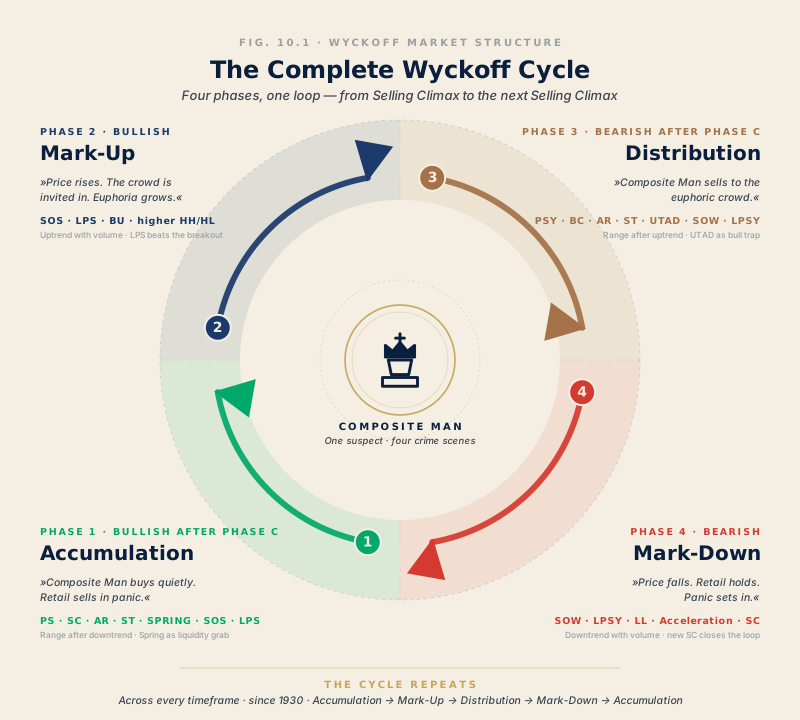
The Spring belongs in the first quadrant of the cycle: accumulation. Here the inventory moves from the market to the operator — from the many who sold during the decline to the one who patiently accumulates. Accumulation has its own inner drama: a selling climax that ends the fall; a first rally; a phase of back and forth in which the low is tested repeatedly without breaking.
The Spring is the last of these tests — and the meanest. It comes late, often after the range has already grown dull and most observers have switched off. It looks like the final failure. In fact it is the confirmation: when the market can no longer fall even though it is being pushed below support, supply is exhausted. What follows is no longer a test but Markup.
That is why the Spring is in the WVPO logo. The sigil is a complete accumulation schematic — and the small dip below the line just before the rise is exactly this moment.
The micro-anatomy — three phases under the lens
On the daily chart a Spring is a wick. A candle with a long lower shadow, nothing more. You see the result, not the process. To see the process you have to zoom in — from the H4 candle down to the 15-minute level. One candle becomes sixteen.
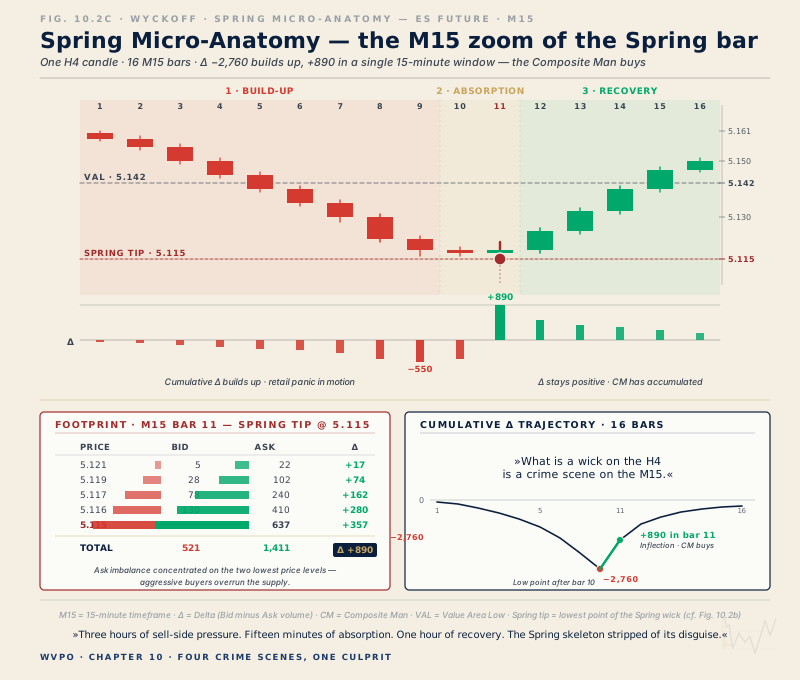
Three phases carry the move:
Phase 1 · Build-up — pressure accumulates
The first nine bars fall. Every candle is red, each closes lower, the cumulative delta — the sum of aggressive buys minus aggressive sells — slides further into the red bar by bar, down to −2,760. This is the phase in which the retail trader acts: support gives way, the chart looks ugly, the mood turns. Selling feels right. That is exactly the purpose. The pressure has to look real, or it won't trigger any stops.
Phase 2 · Absorption — the crime scene
In bars 10 and 11 the opposite of what the chart promises happens. The price reaches the Spring tip at 5,115, the deepest low of the entire move — and does not tip further. Instead the delta jumps +890 higher in a single 15-minute window. In bar 11 there is buying, and aggressive buying at that, precisely where everyone else is having their stops blown out. That is the hand of the Composite Man made visible: he takes the supply the panic produces, in full.
Phase 3 · Recovery — the answer
The last five bars run up. The price reclaims the Value Area Low at 5,142, the delta stays positive, the red candles are gone. What began as a breakdown ends an hour later above the level it started from. The range is intact, the low has held — and the only one who bought down in the depths now holds a position no one else has.
"What is a wick on the H4 is a crime scene on the M15."
The proof lies in the order flow
The suspicion forms in the chart. The proof lies one level deeper — in the footprint of the Spring bar. The footprint breaks a single candle down by price level and shows two numbers for each level: the bid volume (traded at the bid — aggressive sellers hitting into the market) and the ask volume (traded at the ask — aggressive buyers lifting the market). The difference is the delta: positive when the buyers held the initiative, negative when the sellers did. This is exactly where the hand of the Composite Man becomes visible.
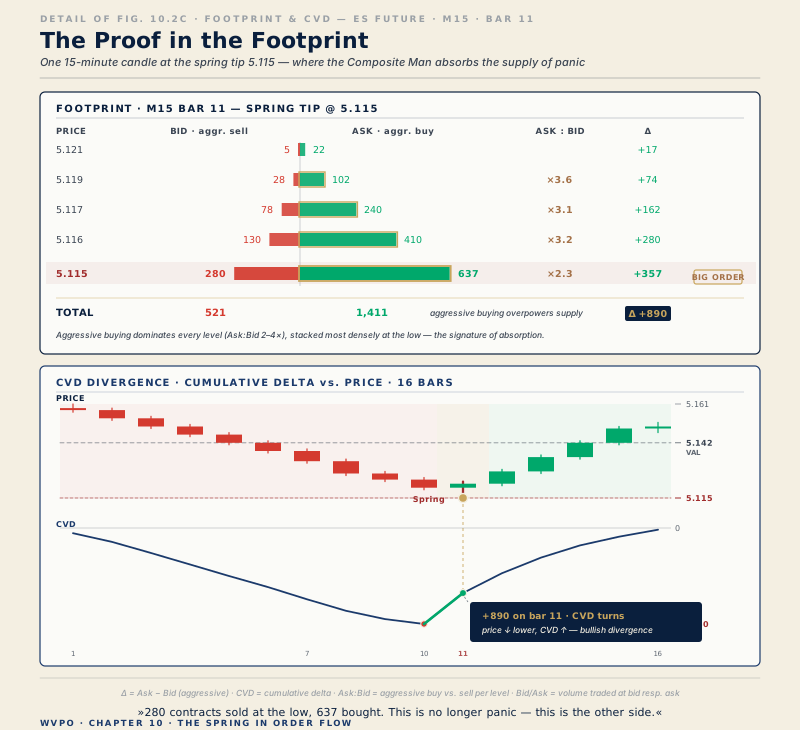
Four signals carry the proof, and they all say the same thing:
1 · The delta — who held the initiative. Read the Δ column from top to bottom: +17, +74, +162, +280, +357. The delta is positive on every price level — and it grows the deeper the price falls. Across the whole bar, 521 aggressively sold contracts face 1,411 aggressively bought: a bar delta of +890. What matters is not the number but its location. The strongest buying happens not at the high of the bar but at its low. Whoever buys most aggressively at the deepest point is not afraid of the fall — he is waiting for it.
2 · The big order — where the hand becomes visible. On the lowest level, the Spring tip at 5,115, 280 aggressive sells meet 637 aggressive buys. That is the single largest entry of the whole bar — the panic of one side and the takeover of the other, in the same 15-minute window, at the same price. The 280 sells are real; it is genuine supply, genuine stops, genuine capitulation. But they are absorbed completely. The price cannot go lower, because someone is standing there who takes every contract offered. That is exactly absorption: not the absence of selling, but its silent disappearance into a larger hand.
3 · The imbalances — stacked buy dominance. An imbalance occurs when the aggressive volume on one side clearly outweighs the other — as a rule of thumb, by a factor of three. In the Spring bar the aggressive buying outweighs the selling on every level of the absorption zone by two to almost four times (ask:bid ×3.6, ×3.1, ×3.2, ×2.3). A single imbalance is noise. Four of them, stacked across the lower price levels, are a statement: the buyers did not strike once, but level by level, tick by tick, bought away the entire supply in the depths.
4 · The CVD divergence — the contradiction that counts. The cumulative delta (CVD) adds up the delta bar by bar. During the build-up it falls with the price — down to −2,760 after bar 10. So far the order flow confirms the downward pressure. Then comes the break in the pattern: in bar 11 the price makes its deepest low (5,115), but the CVD makes none — it turns up with the +890 surge. Price lower, delta higher: a bullish divergence. The price extreme is no longer confirmed by the volume. This is the most reliable single signal in the whole picture, because it cannot be faked — either the aggressive selling carries the new low, or it does not.
None of these four pieces of information exists on the daily chart. There only a wick remains. That is why WVPO runs the order flow as the fourth layer: price action shows where something happens — the footprint shows who is doing it and whether they mean it.
How to trade the Spring — a hypothetical example
Note: the following example is an illustrative teaching case using the figures from Volume I, not a trade signal and not a solicitation to transact. R-multiples are hypothetical. The full risk disclosure applies.
A Spring gives the patient trader something rare: an entry with tightly defined risk and a clear point at which the thesis is disproven. The logic in three steps:
- Wait for confirmation. The Spring tip alone is not yet an entry — it could be a genuine break. Only the recovery, the reclaiming of the Value Area Low at 5,142 with positive delta, confirms the absorption. Whoever catches the depth catches a falling knife; whoever waits for the reclaim trades a proven thesis.
- Stop below the Spring tip. The low at 5,115 is the point where the idea is dead. If the price falls back below it for good, it was not a Spring but distribution — and the stop, just beneath it, ends the trade with a small, defined loss.
- Think in R, not in points. With an entry at the reclaimed 5,142 and a stop below 5,115, the risk is around 30 points. The first target is not a wish price but the next visible supply cluster above the range. Once the price reaches one R, the stop moves to break-even — from there the position costs nothing, but can carry two or three R.
The point is not the number. The point is the asymmetry: a small, known-in-advance loss against an open, multiple profit potential — and an entry that only happens after the proof, not on hope.
What invalidates the Spring
The most dangerous misreading is to treat every dip below as a Spring. Three things separate the Spring from a genuine break, and you have to see all three:
- No absorption, no Spring. If the delta stays negative in the depths, no one is buying. Then the pressure is real and the price keeps falling.
- No reclaim, no Spring. If the price fails to get back above support, supply has won. A Spring that does not return is by definition not one.
- No context, no Spring. Without a preceding accumulation, without a range, without exhausted supply, the move has no reason. A dip below in an intact downtrend is a continuation, not a test.
That is why the Spring is not a signal but a synthesis: context from the Wyckoff cycle, location from the volume profile, structure from the price action, confirmation from the order flow. Only when all four layers say the same thing is the wick on the daily chart what it appears to be — the final stop hunt before the ascent.
Anyone who has once seen the Composite Man absorb the supply of panic in a single 15-minute bar sees the next Spring with different eyes. Not as a break to flee from — but as the question whose answer you already know.
Subscribe to the engine room
New posts by email — double opt-in, unsubscribe anytime, no spam.