WVPO reads markets through four layers of evidence — Wyckoff structure, volume, price action, order flow — instead of news, opinions or lagging indicators.
Structural market analysis means reconstructing where institutional money operates and what traces it leaves behind — and acting only once several independent layers show the same picture.
The core schematic
Read an accumulation — phase by phase
Our sigil is not an ornament: it is a complete Wyckoff accumulation schematic. Here it explains itself — station by station, with the volume profile as a second layer of evidence.
On desktop, your scrolling drives the schematic — or jump straight to a phase with the buttons.
Overview: complete accumulation schematic with price path, volume profile and phases A to E.
Phases A–E
The schematic inside the sigil
A downtrend is stopped, inventory changes hands systematically inside a range, one final push below support collects the liquidity — then the market leaves the range to the upside. This script has five acts.
Volumenprofil · The profile on the left shows where volume was accepted — the Point of Control (copper) is the range's center of gravity.
Phase A
The downtrend is stopped
PS — the first sizable buying slows the decline. SC — panic selling runs into institutional buy limits. AR — with fresh supply absent, price snaps back and defines the upper boundary of the range.
Volumenprofil · A volume cluster forms at the low: someone bought the panic there.
Phase B
The quiet build-up
The longest phase. The ST checks the low, price oscillates between the boundaries. From the outside it looks like sideways noise — in fact the Composite Man absorbs supply piece by piece without driving price.
Volumenprofil · The value area fills layer by layer — the range's institutional memory takes shape.
Phase C
The Spring — the final deception
Price pierces support — exactly where the range buyers' stops sit. The break finds no follow-through selling and returns immediately: liquidity collected, test passed. The Spring is the fingerprint of intent.
Volumenprofil · Below support the profile is thin — barely any accepted volume. The break is a maneuver, not a trend.
Phase D
The proof of strength
SOS — price leaves the range to the upside with spread and volume. LPS — the pullback tests the old boundary from above, the low stays higher, supply stays absent. This is where the operator acts: proof over gut feeling.
Volumenprofil · Volume migrates into the upper half of the range — acceptance above the old resistance.
Phase E
Markup — the trend is running
The range is history, the market seeks higher prices, pullbacks stay shallow. Whoever read the phases has been in the trade since the LPS — with the stop below structure instead of below hope.
Volumenprofil · The POC stays behind as an anchor — distance to the POC becomes the map of the trend.
Enough schematic — see it on a real case.
In the free forensic drill you read the same traces across five years of gold futures: real data, real phases, a real Spring.
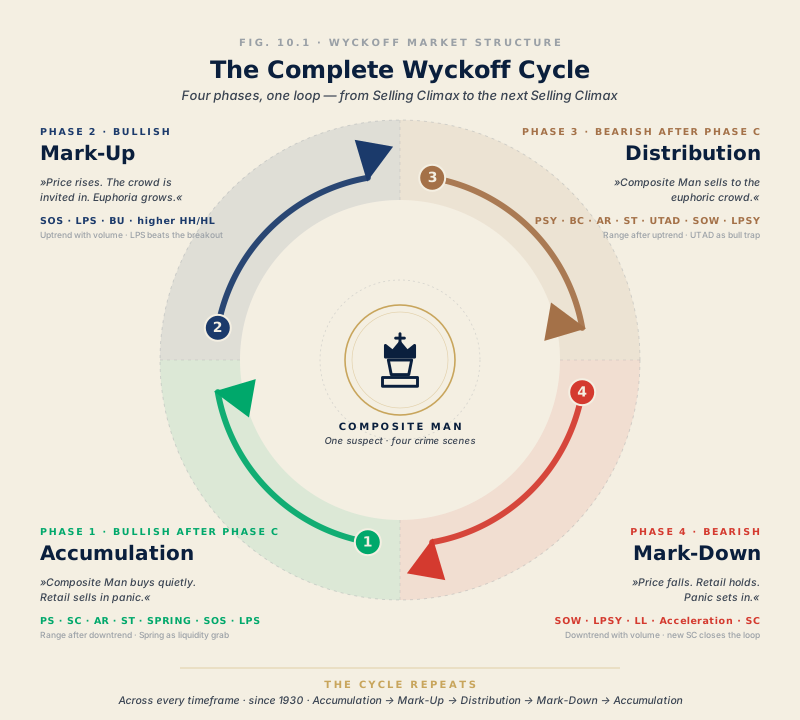
At the top of the cycle the same schematic applies in mirror image: the UTAD instead of the Spring, SOW instead of SOS, LPSY instead of LPS — and markdown instead of markup. If you can read accumulation, you can read distribution.
Schematic mirror — a teaching schematic, not a chart.
The four pillars
Four questions to the market. One process.
Each pillar answers its own question — none replaces another. A trade only happens when the answers converge.
W
Where are we in the cycle?
Wyckoff — the structure
Market phases, trading ranges and the logic of the Composite Man: Wyckoff provides the script in which every move has its place. Without structural context, every signal is just noise.
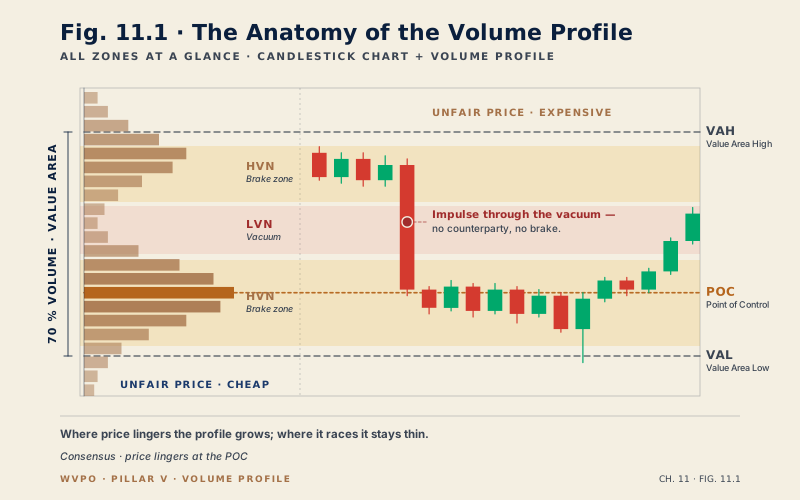
The volume profile shows where positions were built: POC, value area, HVNs and LVNs map institutional activity — price levels where the market left evidence behind.
The anatomy of the profile — figure 11.1 from Volume I.
P
When does the structure break?
Price action — the timing
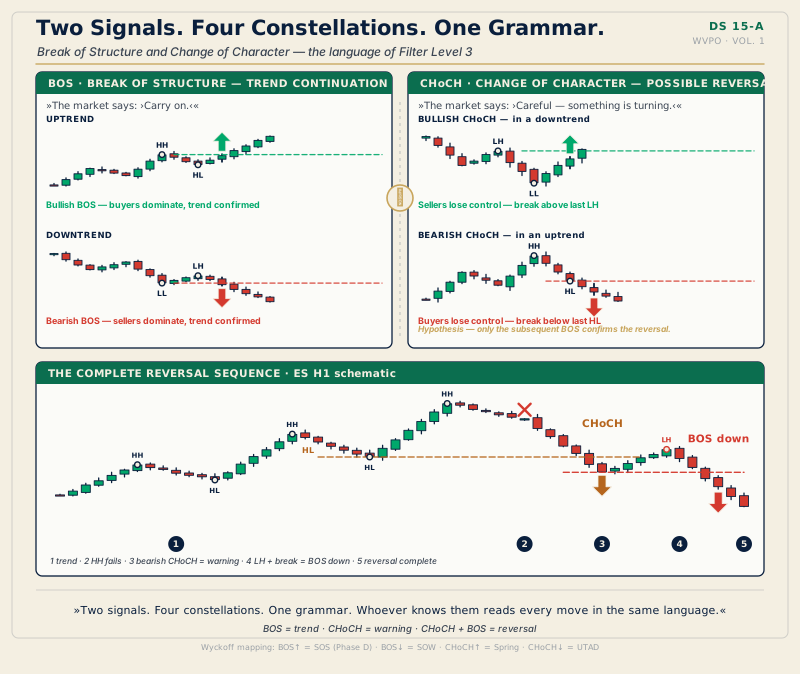
BOS and CHoCH make structure breaks objective; order blocks, FVGs and sweeps show where liquidity is created. Price action translates the context of the first two pillars into precise triggers.
The grammar of structure breaks — diagram from Volume I, chapter 15.
O
Who is aggressive right now?
Order flow — the proof
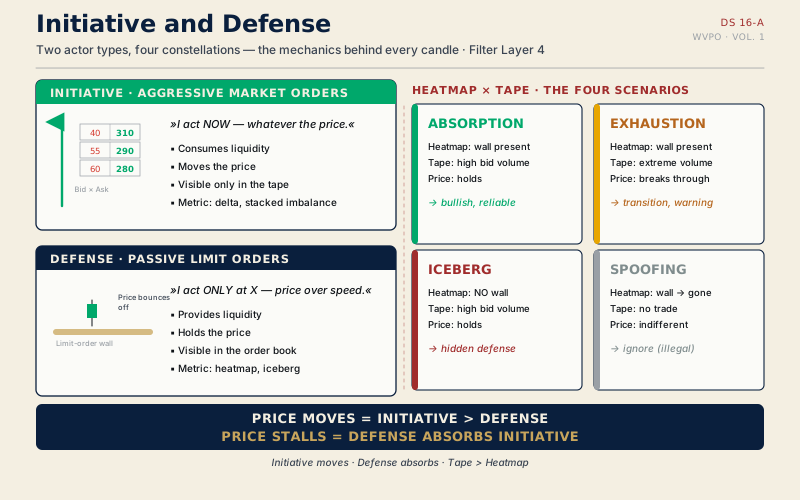
Footprint, imbalance, absorption and delta show in real time whether genuine aggression or a passive wall sits behind a level. Order flow is the final confirmation — right before the entry.
The Operator Academy trains exactly this process: with drills on historical charts, blind replay and a learning path built along the four pillars. Progress is documented publicly in the devlog, and the waitlist is open.